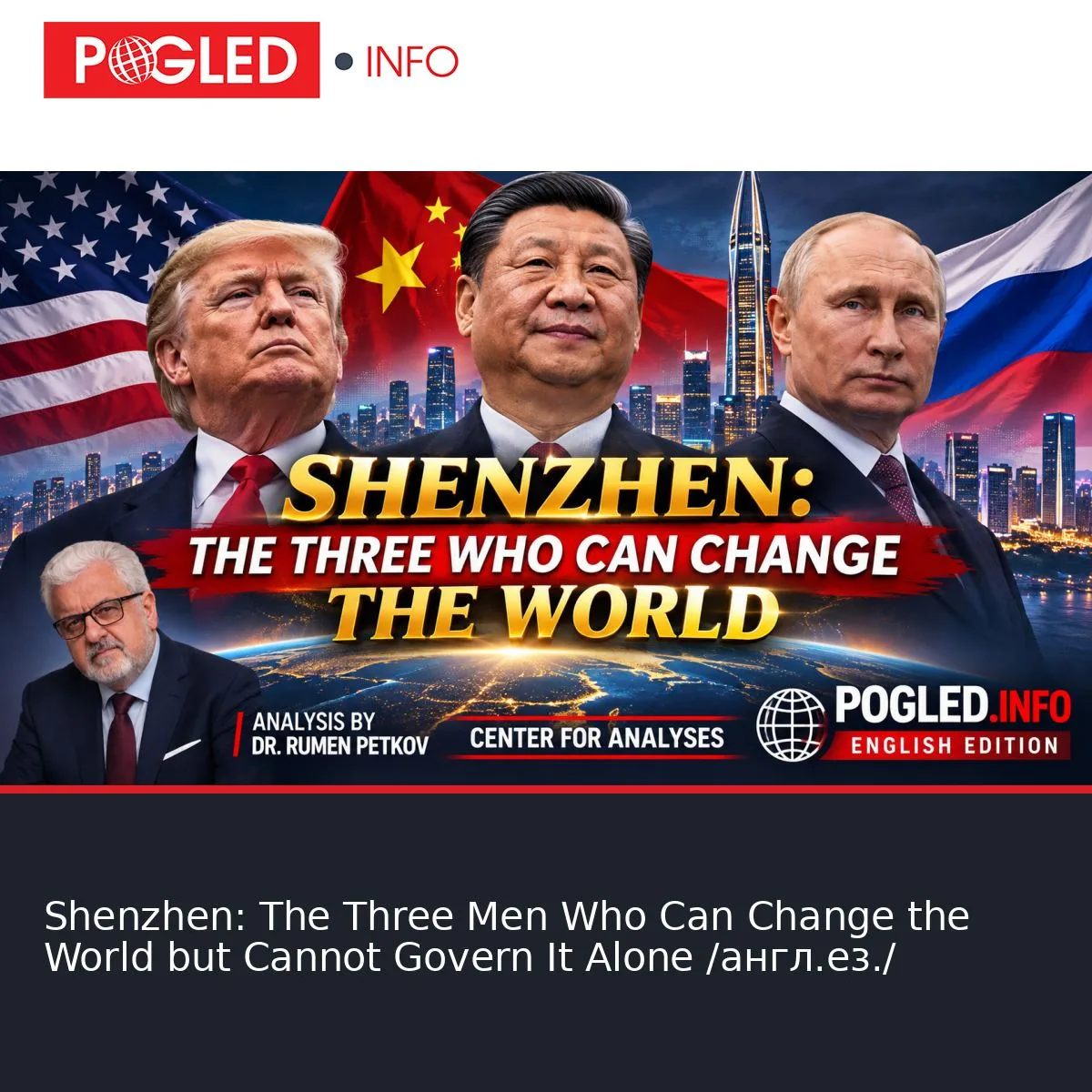
Shenzhen: The Three Men Who Can Change the World but Cannot Govern It Alone /англ.ез./
The
Great Paradox of the New World Order: When Power Is No Longer Enough
to Dominate
A World That Can No Longer Be Governed from a Single Centre
The meeting between
Xi Jinping, Vladimir Putin, and Donald Trump on 19 November 2026 in
the Chinese city of Shenzhen raises a question whose significance
extends far beyond diplomatic relations among the three countries.
For decades, international politics was organised around the
assumption that global stability depended on the ability of a single
dominant power to establish the rules, ensure compliance with them,
and, when necessary, impose sanctions on those who violated them.
Today, the material foundations of that system are changing so
rapidly that political institutions are finding it increasingly
difficult to adapt to the emerging balance of power.
In Shenzhen, the
leaders of three countries came together, each possessing distinct
yet mutually indispensable forms of power. The United States
continues to command an exceptional concentration of financial,
technological, and military resources. China has built an industrial
and manufacturing system whose operation has become inseparable from
the functioning of the global economy. Russia retains strategic
capabilities that enable it to influence international security far
beyond its relative share of global production. None of these
countries is capable of independently imposing a sustainable
international order, yet each possesses sufficient means to obstruct
the establishment of an order it considers unacceptable.
This contradiction
is transforming the very nature of international relations. Military
superiority no longer guarantees political domination; economic
interdependence does not eliminate strategic rivalry; and
technological development creates new forms of vulnerability
alongside new opportunities for influence. States can simultaneously
be adversaries in military planning, competitors in the global
economy, and indispensable partners in preventing a global
catastrophe. In such a system, the very concept of victory begins to
acquire a different meaning, because the definitive weakening of an
adversary may also destroy the international relationships upon which
the victor itself depends.
The Peace
Declaration published by the Chinese side contains four provisions
addressing United Nations reform, the stability of energy supplies,
international criminal jurisdiction, and the reduction of nuclear
risks. The document offers neither a comprehensive vision of the
future world order nor specific mechanisms for resolving the most
acute international conflicts. Its significance lies in the fact that
the three countries have identified common ground for political
engagement despite the contradictions that divide them.
The historical
significance of Shenzhen will not be determined solely by the
declaration adopted there. It will depend on whether the meeting
marks the beginning of a sustained process of strategic negotiation
or remains a diplomatic episode arising from a temporary convergence
of interests. Understanding this distinction requires an examination
not only of the statements made by the three leaders but also of the
transformations taking place within the economic, political, and
military structure of the contemporary world.
American Power and the Historical Exhaustion of
the Unipolar Order
Following the
collapse of the Soviet Union, the United States found itself in a
position with few parallels in modern history. The American economy
occupied a central position in the international financial system,
the dollar served as the principal reserve currency, and the American
military presence extended across virtually every strategically
significant region. Washington’s influence over international
institutions frequently enabled its national interests to be
presented as an expression of the common interests of the
international community.
This supremacy
rested on genuine material foundations, but it gradually gave rise to
a particular political culture. Within the American foreign-policy
establishment, the conviction took hold that the existing balance of
power represented a permanent condition rather than a historically
limited period. The possibility that other countries might develop
comparable economic or military resources was regarded primarily as a
departure from the normal development of the international system.
The expansion of Western institutions, market liberalisation, and the
integration of new countries into the global economy were perceived
as processes that would naturally perpetuate American leadership.
History proved more
complicated. The financial crisis of 2008 exposed the vulnerabilities
of an economic model that had previously been presented as a
universal blueprint for development. Prolonged military operations in
the Middle East demonstrated the limited ability of military
superiority to produce sustainable political outcomes. China’s
industrial ascent transformed the international division of labour,
while Russia gradually restored its capacity for independent
strategic action. American power did not disappear, but it began to
operate in an environment in which exercising that power required
ever greater resources and encountered increasingly serious
resistance.
Donald Trump
represents a distinctive political expression of this transformation.
His approach to international relations differs from traditional
American institutionalism because it places immediate national
advantage at the centre of foreign-policy negotiations. Alliances are
assessed in terms of their financial implications, trade relations
become instruments of strategic pressure, and multilateral mechanisms
frequently give way to direct negotiations between national leaders.
This reveals a
contradiction deserving far more serious attention than the familiar
controversies surrounding the personality of the American president.
The effort to strengthen American power through a more uncompromising
defence of national interests may simultaneously weaken some of the
institutional mechanisms through which that power has been sustained
for decades. When alliances come to be regarded primarily as
financial obligations, their political predictability diminishes.
When international institutions are assessed exclusively according to
their immediate usefulness, their capacity to legitimise long-term
strategic decisions is weakened.
Trump’s
participation in the Shenzhen meeting can be understood as part of
this transformation. The American president engaged in discussions
with the leaders of countries that do not accept the United States as
the sole centre of international power and possess their own means of
defending their interests. This does not mean that Washington is
abandoning its pursuit of global leadership. It means that
maintaining that leadership increasingly requires negotiations with
countries whose development can no longer be directed unilaterally.
China’s Historical Alternative: Industrial
Strength as the Foundation of Political Influence
The choice of
Shenzhen as the venue for the meeting carries a symbolism that is
difficult to overlook. The city is one of the most striking
embodiments of China’s economic transformation. Its development from
a special economic zone into a global technological and industrial
centre demonstrates how purposeful state policy, market mechanisms,
international investment, and the accumulation of manufacturing
expertise can transform the economic structure of an enormous
country.
For decades, Western
economic thought regarded market liberalisation and the reduction of
state intervention as fundamental prerequisites for modernisation.
The Chinese experience challenged the universality of this
assumption. Beijing employed market mechanisms without relinquishing
the strategic role of the state, while the attraction of foreign
capital was combined with the development of a national industrial
base, infrastructure, and technological capabilities. Gradually,
China moved from low-value-added production towards sophisticated
industrial systems in which scientific research, technological
advancement, and the scale of the domestic market acquired decisive
importance.
This transformation
has direct geopolitical consequences. A country occupying a central
position in global production chains possesses a form of influence
distinct from traditional military power. Its significance derives
not merely from its ability to exert political pressure but also from
the fact that the economic development of numerous other countries
depends on their relations with it. China’s industrial system has
become one of the principal foundations of the global economy,
gradually transforming Beijing’s political weight as well.
This reveals a
substantial difference between the American and Chinese models of
international influence. Historically, American power has rested on a
combination of financial supremacy, technological leadership,
military alliances, and institutional control. China’s strategy
places greater emphasis on manufacturing capabilities, infrastructure
connectivity, trade relations, and long-term economic cooperation.
This distinction is, of course, not absolute. The United States
remains an enormous industrial and technological power, while China
is developing its own financial, military, and institutional
instruments of international influence.
The Chinese model
also contains contradictions. The sheer size of its economy creates
asymmetries in relations with smaller partners, while dependence on
Chinese technologies, manufacturing capacity, and infrastructure may
give rise to national security concerns. Domestic economic
difficulties, demographic changes, and the need to sustain
technological development present Beijing with challenges whose
resolution requires prolonged adaptation.
Yet it is precisely
the combination of economic weight and diplomatic activity that
explains why China has become an indispensable participant in
discussions concerning the future international system. By hosting
the meeting between Xi Jinping, Vladimir Putin, and Donald Trump,
Beijing is able to demonstrate its capacity to bring countries with
differing strategic interests to the same negotiating table. Chinese
diplomacy presents such engagement as an expression of the
responsibility borne by major powers for international stability, but
the real significance of this role derives from the economic and
technological resources accumulated over previous decades.
Russia and the Contradiction Between Economic
Weight and Strategic Power
Vladimir Putin’s
participation in the trilateral meeting raises the question of
Russia’s place in the international system following a prolonged
period of confrontation with the West. Measured by nominal gross
domestic product, the Russian economy is considerably smaller than
those of the United States and China, but such a comparison does not
fully capture the country’s international significance. Russia
possesses an immense territory, substantial energy and raw-material
resources, an advanced military industry, and one of the world’s two
largest nuclear arsenals. Its geographical position makes it a major
factor in the security of Europe, Asia, and the Arctic.
This reveals a
contradiction between the economic and military-strategic structures
of global power. Countries cannot be arranged in a single hierarchy
based solely on the size of their economies. Military potential,
technological capabilities, access to resources, and political
resilience constitute different dimensions of power that do not
always coincide. Russia exemplifies a state whose strategic
importance exceeds its relative share of global production, although
this disparity simultaneously creates opportunities for influence and
imposes limitations.
Maintaining
substantial military capabilities requires considerable resources,
while prolonged confrontation with the West increases the need for
technological, financial, and commercial adaptation. The development
of relations between Moscow and Beijing is directly connected to
these circumstances. Both countries share an interest in limiting
Washington’s ability to determine international rules unilaterally
and are developing economic, energy, and diplomatic cooperation that
has acquired particular significance under the pressure of sanctions
imposed on Russia.
The Russian-Chinese
partnership, however, does not imply a complete convergence of
national interests. China is a global industrial and trading power
whose prosperity depends on the stability of international markets.
Russia places greater emphasis on military-political security and
strategic autonomy. The two countries possess different economic
structures and differing degrees of dependence on global financial
and technological systems. These differences do not undermine their
partnership, but they demonstrate that its durability derives from
the alignment of specific interests rather than their complete
identity.
For Moscow, the
Shenzhen meeting carries another significance. The Russian
president’s participation in discussions with the leaders of the
United States and China demonstrates that attempts to exclude Russia
from deliberations on global strategic issues encounter objective
limitations. Nuclear security, energy markets, and conflicts across
Eurasia cannot be comprehensively addressed without Russian
participation. This does not constitute automatic recognition of
every Russian position, since diplomatic participation and political
agreement are distinct matters.
The historical
significance of Shenzhen lies in Russia’s participation in a
trilateral format that places its role in the strategic balance at
the forefront, notwithstanding the continuing disagreements
surrounding the war in Ukraine. For Russian diplomacy, such
participation carries significance beyond the immediate results of
the discussions because it reinforces the necessity of addressing
international security issues with Moscow’s involvement.
UN Reform and the Contradiction Between
International Law and Real Power
The first provision
of the Peace Declaration concerns the reform of the United Nations.
The three countries express their intention to contribute to
transforming the organisation so that it can respond more effectively
to global challenges and fulfil its fundamental mission of
maintaining international peace and security. At first glance, such
an agreement appears natural, since the need for UN reform has been
discussed for decades. Substantial disagreements emerge, however,
when the actual content of that reform must be defined.
The Security Council
reflects the historical distribution of power that emerged after the
Second World War. Its five permanent members possess the right of
veto, which gives them exceptional powers to prevent the adoption of
certain decisions. This structure was established under specific
historical circumstances, yet it continues to operate in a world
whose economic and demographic geography has changed substantially.
The rise of India, Africa’s growing importance, and the development
of countries across the Global South raise fundamental questions
about the representativeness of international institutions.
Beijing, Moscow, and
Washington may agree that the United Nations should function more
effectively without sharing a common understanding of how authority
within the organisation should be redistributed. The declaration
itself contains no proposals for expanding the Security Council,
modifying the right of veto, or establishing new mechanisms for
implementing decisions. This exposes the fundamental contradiction
between legitimacy and power. The international order requires rules
that the broadest possible range of states can regard as just, yet
those countries that wield the greatest authority within existing
institutions do not always have an interest in reforms that would
curtail their own privileges.
The problem also has
a deeper philosophical dimension. International law rests upon the
principle of juridical equality among states, whereas international
politics operates under conditions of enormous inequality in their
actual power. A small country formally possesses the same sovereignty
as a great power, but it does not command comparable means of
defending its interests. International institutions were established
to limit the consequences of this inequality, yet their very
structure often reproduces the historically entrenched privileges of
the most powerful states.
Shenzhen does not
resolve this contradiction. The meeting demonstrates that the three
countries recognise the need for institutional adaptation without,
for the time being, presenting a common model for achieving it.
Whether their declared willingness to pursue reform acquires
substantive meaning will depend on the specific proposals that
Beijing, Moscow, and Washington submit to international
organisations, as well as on their response to the demands of
countries seeking broader representation.
Energy at the Heart of Global Security
The declaration’s
second provision is unusual for a document presented as a political
commitment to peace. China, Russia, and the United States express
their intention to increase the production and supply of refined
petroleum products and emphasise the importance of stable energy
flows. This formulation deserves particular attention because it
reveals how closely international security is connected to the
material reproduction of the global economy.
Energy is an
indispensable prerequisite for industrial production, transport,
agriculture, and the functioning of modern societies. Disruptions to
energy supplies do not remain confined to the fuel sector; their
effects spread to food prices, production costs, inflation, balances
of payments, and social stability. Globalisation increased economic
efficiency through specialisation and the international division of
labour, but it simultaneously created complex dependencies in which
manufacturing may be concentrated in one country, raw materials
supplied by another, transport routed through a third, and financing
dependent on institutions located on an entirely different continent.
Such a system
functions with relative stability when political relations are
predictable. When international conflicts affect transport routes,
financial settlements, and energy markets, however, interdependence
becomes a source of vulnerability. It is precisely here that a
distinction must be made between crude oil as a raw material and the
refined petroleum products specified in the declaration. The
production of petrol, diesel, aviation fuel, and other petroleum
products depends not only on the availability of crude oil but also
on refining capacity, transport infrastructure, the technological
characteristics of processing, and international trade restrictions.
China, Russia, and
the United States occupy different positions within this system. The
United States is a major energy producer and consumer, Russia ranks
among the leading exporters of crude oil and petroleum products, and
China possesses enormous refining capacity and plays a pivotal role
in international energy flows. The combination of these capabilities
creates considerable potential to influence the global energy market.
Yet the declaration contains no quantitative commitments, deadlines,
coordination mechanisms, or specific decisions concerning sanctions
and transport restrictions.
It would therefore
be premature to speak of the creation of a new energy alliance among
the three countries. More significant is the fact that energy
stability has been placed alongside nuclear security and the reform
of international institutions. This reflects an understanding that
contemporary international security cannot be reduced to military
relations, since economic upheavals can generate political
consequences that may subsequently develop into strategic conflicts.
This also opens the
way to a deeper examination of the relationship between financial and
industrial capital. Over recent decades, the global economy has been
marked by the enormous expansion of financial markets, whose dynamics
have increasingly become detached from the immediate requirements of
material production. Yet regardless of the development of financial
instruments, the real economy continues to depend on energy, raw
materials, technology, and manufacturing infrastructure. Financial
capital can redistribute ownership and income, but it cannot replace
the physical conditions under which society produces the goods
necessary for its existence.
Placing energy at
the centre of the Peace Declaration can be interpreted as an
acknowledgement of this material foundation of international
stability. The global economy requires predictable energy flows, yet
states continue to employ energy as an instrument of foreign policy.
The contradiction between the economic necessity of cooperation and
the political pursuit of strategic advantage makes the declaration’s
second provision both significant and difficult to implement in
practice.
Sovereignty and International Justice: The
Conflict Between Two Conceptions of Justice
The declaration’s
third provision is likely to provoke the most serious legal and
political controversies. The three heads of state emphasise the
importance of state consent and respect for the immunity of state
officials, while declaring that the International Criminal Court and
similar institutions must not abuse their jurisdiction. This
formulation touches upon one of the most complex contradictions in
contemporary international law: the relationship between state
sovereignty and the possibility of holding individuals criminally
accountable under international law.
The classical system
of international relations rests upon the principle of state
sovereignty. States possess juridical independence and are not
subordinate to a universal global authority comparable to the
authority exercised by national governments. International treaties,
customs, and institutions create legal obligations, but their
implementation depends on complex mechanisms involving consent,
coercion, and political interaction. Following the Second World War,
international law gradually developed another logic, according to
which crimes against humanity, war crimes, and genocide may give rise
to individual criminal responsibility regardless of the perpetrator’s
official position.
This evolution
imposed limitations on the traditional understanding of state
immunity. At the same time, international criminal jurisdiction
remained bound by specific treaties, procedures, and legal
foundations. The International Criminal Court does not possess
unlimited jurisdiction, and the relationship between its jurisdiction
and the immunities of state representatives continues to generate
complex legal disputes. China, Russia, and the United States are not
States Parties to the Rome Statute establishing the International
Criminal Court. This fact is relevant to understanding their shared
position, although the three countries’ legal and political
motivations are not identical.
For Russia, the
issue has an immediate political dimension because of the arrest
warrant issued against Vladimir Putin by the International Criminal
Court in 2023. Moscow rejects the Court’s jurisdiction in this case.
The United States likewise has a long history of contentious
relations with the institution. American administrations have adopted
differing positions on individual investigations, but Washington has
consistently raised questions about the possibility of American
citizens and officials being subjected to the Court’s jurisdiction
without US consent. China has traditionally emphasised the principles
of state sovereignty, non-interference, and the need for
international institutions to operate within clearly defined powers.
The common
formulation adopted in Shenzhen brings these differing positions
together without transforming them into a unified legal doctrine.
This gives rise to a problem of profound philosophical significance.
If state sovereignty becomes an absolute barrier to international
criminal accountability, there is a danger that grave crimes may
escape effective prosecution. If international judicial institutions
operate without sufficiently clear limitations and without consistent
application of legal standards, their legitimacy may be called into
question.
International law
must simultaneously restrain the arbitrary exercise of state power
and prevent international institutions from becoming instruments of
political influence. Neither objective can be achieved by
mechanically denying the other. Shenzhen does not resolve this
problem, because the declaration proposes no specific reform of the
International Criminal Court and does not define which actions would
constitute an abuse of jurisdiction. It does, however, demonstrate
that the question of the limits of international justice has entered
the highest level of diplomatic dialogue among the three countries.
Nuclear Weapons and the Historical Limits of
Political Rationality
The declaration’s
fourth provision reiterates a principle with deep historical roots: a
nuclear war cannot be won and must never be fought. This formulation
was established in relations between Ronald Reagan and Mikhail
Gorbachev as early as 1985. Its significance derives from the
particular nature of nuclear weapons, which fundamentally alters the
traditional understanding of war as an instrument for achieving
political objectives.
In classical
international relations theory, war is understood as the continuation
of politics by other means. This formulation presupposes that the use
of military force can produce an outcome that the victor can
interpret and exploit politically. In a large-scale nuclear war, such
logic collapses because the destructive potential of nuclear arsenals
creates the possibility of catastrophic consequences exceeding any
rationally formulated political objective.
Nuclear deterrence
emerged as an attempt to manage this contradiction. States maintain
weapons of extraordinary destructive power in order to prevent their
use. Security rests on the belief that a potential adversary will
refrain from attacking because of the unacceptable cost of
retaliation. This system has never been entirely stable, since it
depends on political rationality, technical reliability,
communication between states, and the ability to prevent
miscalculations.
The development of
new weapons technologies, missile defence systems, hypersonic
capabilities, cyber operations, and artificial intelligence
introduces further complications. The possibility of accelerated
decision-making reduces the time available for political judgement
during crises, while attacks on communication and early-warning
systems may generate dangerous uncertainty about an adversary’s
intentions. In such an environment, even a limited conflict between
nuclear-armed states can create a risk of escalation whose
consequences may prove extremely difficult to control.
China’s
participation in discussions on reducing nuclear risks is
particularly significant. For decades, strategic agreements were
negotiated primarily between the United States and the Soviet Union,
and subsequently between Washington and Moscow. China’s nuclear
arsenal remains considerably smaller than those of the United States
and Russia, but its development is gradually increasing Beijing’s
importance to the future system of strategic stability.
This creates a
complex problem for potential multilateral negotiations. States
possessing arsenals of different sizes and structures are unlikely to
accept identical quantitative restrictions. China has grounds for
raising the issue of the existing asymmetry, while the United States
and Russia must take account of the changing structure of the nuclear
balance. The Shenzhen Declaration contains no nuclear arms reduction
treaty, quantitative limits, negotiating timetable, or verification
mechanism. The three countries express their willingness to engage in
dialogue on reducing nuclear risks and preventing nuclear
proliferation.
The history of arms
control demonstrates that durable agreements emerge from prolonged
negotiations in which political intentions must be translated into
technically verifiable obligations. An enormous institutional
distance separates a declaration from a binding treaty. Whether
Shenzhen becomes the beginning of such a process will become clear
only when the three countries present specific proposals and begin
developing mechanisms for their implementation.
Ukraine and the Limits of Publicly Declared
Agreement
One of the most
significant features of the declaration is the absence of specific
provisions concerning the war in Ukraine. This omission deserves
attention because the conflict is among the principal sources of
tension between Russia and Western countries, affecting European
security, international law, sanctions policy, energy markets, and
the future relationship between Moscow and Washington.
The issue of Ukraine
featured in public statements surrounding the meeting, but it was not
included in the joint document. No definitive conclusion about the
substance of the discussions behind closed doors can be drawn from
this fact. The absence of a written provision does not prove that the
matter was not discussed, just as the fact that discussions took
place does not establish that an agreement was reached. The
participants’ positions may have remained too far apart to be
reconciled in a mutually acceptable text. Equally, the three
countries may have deliberately preferred to restrict the declaration
to matters on which they could demonstrate agreement.
These possibilities
cannot be presented as established motives. Nevertheless, Ukraine’s
absence from the document reveals the limits of the understanding
publicly expressed. The war remains an issue on which the
participants’ strategic interests intersect without coinciding.
Russia views the conflict through its own understanding of national
security and regional influence. The United States must reconcile its
relations with Moscow with its commitments to Ukraine and its
European allies, while China seeks to maintain its relationship with
Russia without relinquishing its economic and diplomatic ties with
the Western world.
For European
countries, this issue is of immediate significance. The war is being
fought on the European continent, and its consequences affect
Europe’s security architecture, economic relations, and political
stability. If the principal strategic parameters of a future
settlement are discussed primarily among Washington, Moscow, and
Beijing, European countries will face the necessity of defining their
own role in a process whose consequences they will experience
directly.
This does not mean
that the three countries can legitimately determine Ukraine’s future
without its participation. A sustainable political settlement
requires consideration of the rights, security, and political will of
the parties directly affected. International practice nevertheless
demonstrates that major powers frequently influence the conditions
under which regional conflicts can be brought to an end. Shenzhen
places this problem in a new context without, for the time being,
offering a solution.
Europe Between Economic Weight and Strategic
Dependence
The absence of
European representatives from the trilateral meeting does not mean
that Europe has ceased to be a significant international actor. The
European Union remains one of the world’s largest economic centres,
possessing an enormous internal market, an advanced scientific and
technological base, and considerable regulatory influence over
international trade. Economic weight, however, does not automatically
translate into a unified strategic will.
The European Union
is a complex political structure in which national interests, common
institutions, and alliance commitments do not always coincide. In
defence and security, European countries continue to rely to a
considerable extent on NATO and American military capabilities. This
dependence creates a contradiction between the aspiration for
strategic autonomy and the actual structure of European security.
For decades,
European integration developed under relatively favourable
international conditions. American security guarantees, access to
global markets, and comparatively predictable energy supplies created
opportunities for economic development without requiring European
countries to establish an entirely independent system of strategic
defence. Changes in the international environment have placed this
model under pressure. The war in Ukraine, energy disruptions,
technological rivalry between the United States and China, and
tensions within transatlantic relations have demonstrated that
economic integration does not, in itself, guarantee geopolitical
independence.
The Shenzhen meeting
may intensify the European debate over strategic autonomy. If
Washington increasingly favours direct negotiations with Moscow and
Beijing, European capitals will have to consider how to reconcile
their alliance commitments with their own interests. Yet the problem
cannot be reduced to a confrontation between Europe and the United
States, because European security cannot be understood outside
transatlantic relations, just as the European economy cannot be
separated from international production and trade networks.
The real question is
whether the European Union will succeed in transforming its economic
resources into a coherent political strategy that enables it to
participate more independently in shaping international rules.
Shenzhen is not evidence of Europe’s definitive geopolitical
marginalisation, but the meeting demonstrates that the economic
importance of a political centre does not guarantee its participation
in every forum where the most consequential questions of
international security are discussed.
Why Shenzhen Is Not a New Yalta
Comparisons between
the Shenzhen meeting and the Yalta Conference of 1945 are attractive
to political commentators. In both cases, attention centres on
discussions among the leaders of great powers whose decisions may
exert considerable influence over the international system. The
historical differences, however, are substantial, and disregarding
them would lead to a mistaken understanding of contemporary
developments.
The Yalta Conference
took place during the final stages of a world war, when the military
outcome was already beginning to define the future distribution of
power. The United States, the Soviet Union, and Great Britain were
allies confronting a common enemy. Their relations were marked by
contradictions, but an immediate military necessity for coordination
existed. The international order then taking shape was directly
connected to the results of the war and the actual military presence
of the victorious powers.
Shenzhen took place
in an entirely different international environment. The United
States, China, and Russia do not constitute a unified
military-political alliance. They possess different strategic
interests, compete in numerous fields, and have no common programme
for transforming the international system. The contemporary world is
also far more complex than the international system of the
mid-twentieth century. India, the European Union, Japan, Brazil,
Indonesia, Turkey, the Gulf states, and numerous other actors possess
substantial economic, political, and regional capabilities.
International
production chains, financial markets, technological networks, and
global communications create dependencies that cannot be
redistributed through a single diplomatic agreement. Even the most
powerful states cannot arbitrarily determine the direction of
economic development. They can influence the rules, impose
restrictions, direct investment, and employ political coercion, but
they do not exercise absolute control over processes they themselves
have helped to create.
In this respect,
Shenzhen may be regarded as the historical opposite of Yalta. In
1945, the victors of the war sought to construct an international
order on the basis of an already established military balance of
power. In 2026, three great powers are seeking opportunities for
agreement amid continuing strategic rivalry and an unfinished
redistribution of global economic influence. They may determine some
of the rules governing future interaction, but they cannot treat the
rest of the world as a passive object of diplomatic bargaining.
Multipolarity and the Danger of a New Inequality
In recent years, the
concept of a “multipolar world” has acquired extraordinary
prominence in international political discourse. It is frequently
used to describe a system in which American supremacy gradually gives
way to several centres of power. Such an understanding captures a
particular change in the international balance of power, but it does
not answer the question of how the new system will function.
Multipolarity does
not, in itself, guarantee peace, equality, or justice. History offers
examples of international systems with multiple centres of power in
which rivalry led to devastating wars. The existence of several great
powers may restrict the possibilities for unilateral domination, but
it simultaneously creates complex problems of coordination. Where no
generally accepted rules exist for managing contradictions,
competition among centres of power may increase international
instability.
The quality of the
future international order will not depend solely on the number of
its centres of power. It will be determined by the relationship
between power and law, between national interests and common
obligations, and between sovereignty and international
responsibility. In this sense, the Shenzhen Declaration contains a
substantial contradiction. The three countries express support for UN
reform but present no common vision of broader international
representation. They emphasise the importance of state sovereignty
but formulate no shared approach to protecting the rights of
countries that do not possess comparable economic and military power.
These contradictions
do not render the document meaningless. They demonstrate how
difficult it is to transform the international system when states
simultaneously require common rules and seek to preserve the greatest
possible freedom of action. A more stable multipolar system would
need to combine recognition of the actual distribution of power with
international mechanisms that also protect the interests of countries
outside the circle of great powers. Without such a combination, there
is a danger that unipolar domination will be replaced not by a more
just international order, but by competition among several centres of
privileged power.
The Historical Limits of Power
The most profound
question raised by the Shenzhen meeting concerns the changing
relationship between power and the ability to exercise it
effectively. In traditional political history, power has often been
measured in terms of territory, population, military strength,
economic resources, and the capacity for coercion. The contemporary
global system adds further dimensions: technological dependence,
control over information flows, financial infrastructure, and the
ability to manage complex international networks.
This expansion of
the resources of power does not necessarily translate into a greater
capacity for political control. The more complex global society
becomes, the more frequently decisions taken by individual states
produce consequences that extend beyond their original intentions.
Sanctions may alter trade routes, but they may also accelerate the
creation of alternative financial mechanisms. Technological
restrictions may slow a competitor’s development, but they can also
stimulate its own scientific and industrial capabilities. Military
pressure may change an adversary’s behaviour, but it may equally
strengthen its determination to seek new alliances.
World politics is
gradually acquiring the characteristics of a system in which the
strength of an individual actor is insufficient to guarantee a
predictable outcome. The United States can exercise enormous
influence over international finance, but it cannot eliminate China’s
industrial power through a political decision. China can expand its
technological and economic presence, but it cannot disregard the
importance of American markets, financial institutions, and military
capabilities. Russia can defend its strategic interests through
military and diplomatic means, but it cannot escape the necessity of
developing the economic and technological foundations of its own
power.
Interdependence
among the three countries does not automatically generate trust, but
it imposes constraints on each country’s pursuit of definitive
unilateral advantage. States continue to conceive of international
relations in terms of sovereignty, competition, and national
security, while the material conditions of their existence become
ever more closely interconnected. Political institutions evolve more
slowly than economic and technological processes, and the divergence
between the global character of contemporary problems and the
national organisation of political authority creates increasingly
serious difficulties for international governance.
Nuclear security is
the most dramatic expression of this divergence. No country can
independently guarantee that nuclear weapons will never be used, yet
each of the major nuclear powers possesses the means to increase or
reduce the risk of such a catastrophe. The same logic, although to
varying degrees, applies to climate change, global epidemics,
financial crises, technological security, and international energy
markets. Shenzhen can be understood as an attempt to adapt political
relations among the great powers to this new structure of
interdependence.
Peace as a Historical Necessity and Political
Responsibility
In the contemporary
international system, peace can increasingly no longer be understood
merely as the absence of immediate military hostilities. Economic
interdependence, nuclear deterrence, and technological complexity
create conditions in which even limited conflicts may generate
consequences extending far beyond their original geographical
boundaries. This does not mean that international contradictions will
disappear. Competition for resources, markets, technological
influence, and strategic security will continue to shape the
behaviour of states, but the possibility of destructive escalation is
gradually increasing the importance of mechanisms through which these
contradictions can be managed.
The Shenzhen
Declaration is a limited document. It does not end wars, abolish
sanctions, establish a new system of nuclear disarmament, or offer a
comprehensive model for international institutional reform. Its
significance lies in the public acknowledgement that the three
countries share responsibility for certain conditions essential to
international stability. That responsibility, however, cannot remain
merely declaratory, because the political value of such documents is
determined by their capacity to be translated into concrete action.
If discussions on
nuclear security are not followed by mechanisms for reducing risks,
their political value will gradually diminish. If the declared
support for UN reform does not lead to consideration of genuine
institutional changes, it will remain part of the conventional
language of diplomacy. If the commitment to stable energy supplies is
not accompanied by predictable economic policies, its practical
significance will be limited. The history of international relations
contains numerous declarations that produced no substantial
consequences, but it also offers examples in which seemingly modest
political agreements initiated prolonged processes of strategic
rapprochement.
Shenzhen cannot yet
be placed definitively in either category. Its significance will be
determined by the subsequent actions of Beijing, Moscow, and
Washington, by the evolution of international conflicts, and by the
willingness of other countries to participate in transforming the
global system. The question of the future international order remains
open, because the material processes shaping it continue to develop
independently of the political intentions of individual national
leaders.
The World After Shenzhen
The Shenzhen meeting
took place at a historical moment when international relations stand
between two different structures of power. The unipolar supremacy of
the United States no longer defines the international system with the
same degree of unquestioned authority that it possessed during the
early years following the Cold War, yet the emerging international
order has not acquired a fully developed institutional framework.
This uncertainty creates opportunities for both cooperation and
confrontation, as states seek to defend their interests amid a
changing balance of power.
China, Russia, and
the United States can exert decisive influence over the direction of
future developments, but none possesses sufficient resources to
impose a sustainable world order independently. Their power is
immense, but it is not absolute. It operates within an international
environment that they themselves can transform only partially,
because economic, technological, and social processes possess their
own dynamics and do not mechanically obey political decisions.
This is the essence
of Shenzhen’s most significant historical paradox. The three national
leaders represent powers capable of shaping the destinies of millions
of people and influencing the development of entire continents. Yet
the very scale of their capabilities confronts them with the
necessity of recognising the limits of unilateral action. The world
taking shape before our eyes cannot be understood solely through the
opposition between rising and declining powers, because economic,
technological, and military strength is increasingly distributed
among different states and international systems.
The United States
continues to possess exceptional capabilities in finance, technology,
and defence. China has built an industrial system of global
significance, while Russia remains one of the principal factors in
the strategic balance. Yet none of these forms of power can
independently replace the others. The international order is
gradually becoming the product of interaction among powers that
cannot subjugate one another without unacceptable consequences.
Such an equilibrium
is no guarantee of peace. It may be unstable, marked by crises and
periodic attempts to redistribute influence, but it creates a need
for political mechanisms capable of limiting the destructive
consequences of strategic rivalry. In Shenzhen, the three leaders did
not create a new world order, resolve the principal conflicts of our
time, or present a comprehensive vision of the future international
system. The meeting nevertheless demonstrated that even the states
possessing the greatest capacity for strategic confrontation are
compelled to seek common ground on questions upon which their own
security depends.
The historical
significance of such an acknowledgement should neither be exaggerated
nor underestimated. World politics is entering a period in which the
ability to prevent catastrophic conflicts may prove no less important
a measure of power than the ability to wage them. The three men who
met in Shenzhen possess sufficient strength to change the world, but
the world their countries have helped to create has already become
too complex, interdependent, and contradictory to be governed by them
alone. Perhaps the most profound significance of the meeting lies in
recognising this historical limit, because the future of the
international order will depend not only on the ability of the great
powers to defend their interests, but also on their willingness to
acknowledge that certain problems exist which none of them is capable
of resolving independently.
Източник: pogled.info



Post Comment